
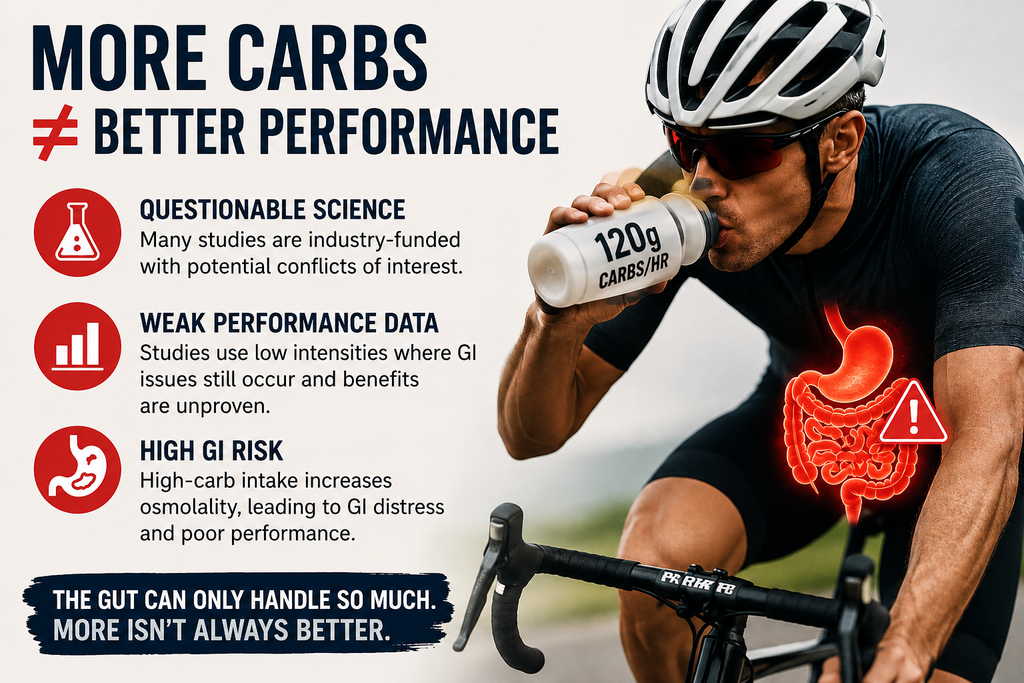
HIGH CARBOHYDRATE FUELLING - HAMMER NUTRITION'S TAKE
 The biggest issue with the whole “more carbs = better performance” idea is that there is precious little evidence, outside of limited science and mostly anecdotal experience from cyclists in the professional peloton, to support it. There is no proof from any pro teams that these riders are consistently following these excessive calorie and carbohydrate intake protocols. More importantly, why should amateur athletes try to copy what top-level professionals are supposedly doing? These are young, genetically gifted athletes whose full-time job is to train, recover and sleep. What works for them is not necessarily what will work best for the rest of us.
Questionable science: Many of the studies used to support high-carbohydrate fuelling are funded by industry groups. One of the key figures, Dr Asker Jeukendrup, helped popularise the 2:1 glucose-to-fructose ratio, which was quickly followed by product launches from companies linked to the research.
Weak performance data: In all of Jeukendrup’s “multi-carb” studies, the athletes exercised at intensities far below those typically seen in professional road racing. Even at these lower intensities, many athletes still experienced gastrointestinal distress. In addition, a well-known study promoting 90g of carbohydrate per hour found that only half of the athletes could even complete the 205-minute test. They were also exercising at just around 50% of maximum oxygen uptake and rode at a pace far below race intensity.
The question is: What benefit is there in trying to increase carbohydrate intake to match a moderate training pace? According to exercise physiologist Dr Carl Foster, “The frequency of abdominal complaints and symptoms during high-intensity or competitive exercise (Brouns et al., 1987) suggests that attempting to feed while gastric emptying rate is suppressed by high-intensity exercise may be inherently futile.” In simple terms, the gut can only process so many calories during exercise. Trying to consume more calories in the hope of replacing what you are burning — or even getting close to it — places a huge strain on digestion and often results in unpleasant, performance-limiting stomach issues.
Higher GI risk: The “superiority of multiple carbohydrates” argument is based on glucose (maltodextrin) using one transport pathway in the gut (SGLT1) and fructose using another (GLUT-5). What is often left out of the discussion is osmolality. When simple sugars and complex carbohydrates are combined, as they are in many modern sports fuels, the concentration and osmolality of the mixture can increase dramatically. This can reduce the efficiency of digestion and absorption for neither carbohydrate source. That is why, despite claims of improved performance, real-world athletes are frequently left dealing with bloating, cramping, nausea and other gastrointestinal problems rather than better results