
What Makes the Best Energy Gel for Endurance Cycling, Running and Triathlon?
The best energy gel for endurance sport isn't simply the one that packs in the most carbohydrate. During a long ride, marathon, triathlon or extended training session, you need energy that you can consume repeatedly without excessive sweetness becoming increasingly difficult to tolerate.
That is where the type of carbohydrate used in an energy gel matters.
Many conventional energy gels rely heavily on simple sugars such as glucose, fructose and sucrose. Hammer Nutrition takes a different approach: Hammer Gel uses maltodextrin as its primary carbohydrate source, allowing athletes to obtain concentrated carbohydrate energy with considerably less sweetness than a formula dominated by simple sugars.
Why Maltodextrin Makes Sense for Endurance Fuelling
Maltodextrin consists of chains of glucose molecules rather than individual simple-sugar molecules. Although it is rapidly digested and provides readily available carbohydrate during exercise, its molecular structure gives it some useful practical characteristics for endurance nutrition.
Compared with gels dominated by simple sugars, maltodextrin offers several advantages:
- Less sweetness: Maltodextrin is considerably less sweet than simple sugars. This can become increasingly important when consuming sports nutrition repeatedly during several hours of exercise.
- Efficient carbohydrate delivery: Maltodextrin provides readily available carbohydrate to help fuel working muscles during endurance exercise.
- Lower osmolality for an equivalent carbohydrate concentration: Because maltodextrin molecules are larger than individual glucose molecules, more carbohydrate can be delivered with fewer dissolved particles. This is one reason maltodextrin is widely used in endurance nutrition.
- No need to rely on large amounts of simple sugars: Hammer Gel's primary carbohydrate source is maltodextrin rather than a formula dominated by glucose, sucrose or fructose.
- Practical for prolonged exercise: Its mild sweetness makes Hammer Gel particularly suited to athletes who need to consume fuel repeatedly during longer sessions.
This doesn't mean simple sugars cannot provide energy during exercise—they can. The difference is how the product is formulated and how comfortably an athlete can continue consuming it hour after hour.
What to Look for When Comparing Energy Gels
When choosing an energy gel for cycling, running or triathlon, consider:
- Carbohydrate source: Read the ingredients rather than relying solely on the carbohydrate number on the front of the packet. Compare gels dominated by glucose, fructose or sucrose with those using maltodextrin as their primary carbohydrate source.
- Digestive tolerance: What works during a short training session may feel very different after several hours. Test your gel repeatedly during longer training sessions.
- Sweetness and flavour fatigue: Very sweet products can become increasingly difficult to consume during prolonged endurance exercise. Maltodextrin's lower sweetness is one reason Hammer favours it.
- Caffeine: Caffeinated gels can be useful strategically, while caffeine-free flavours allow athletes greater control over their total caffeine intake.
- Portability: Your gel needs to be easy to carry in a jersey pocket, running belt or race vest and straightforward to consume on the move.
- Overall fuelling strategy: Gels should complement your carbohydrate, fluid and electrolyte intake rather than being considered in isolation.
- Cost per serving: If you use gels regularly, a bulk format can significantly reduce packaging and cost per serving.
Why Hammer Gel Is Different
Hammer Gel is built around a simple principle: provide useful endurance energy without making simple sugars the foundation of the formula.
Maltodextrin is its primary carbohydrate source, giving athletes readily available carbohydrate in a less intensely sweet format that's particularly well suited to repeated consumption during endurance exercise.
Hammer Gel also provides:
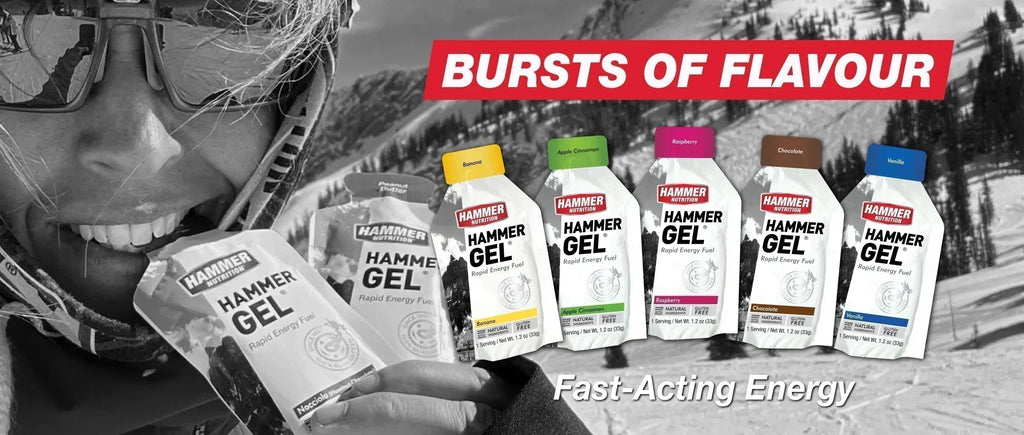
- 12 flavours to reduce flavour fatigue and give athletes greater choice
- Caffeinated and caffeine-free options for more controlled caffeine use
- Compact single-serving sachets for running, cycling and triathlon
- A smooth consistency that's easy to consume during exercise
- A 26-serving Hammer Gel Jug for athletes who use gels regularly
- A reusable flask option for carrying multiple servings with less individual packaging
For endurance sessions extending beyond approximately three hours, Hammer Gel can also provide variety alongside a sustained endurance fuel such as Perpetuem, with electrolyte and fluid intake adjusted according to conditions and individual requirements.
If you've only ever used conventional sweet, simple-sugar-based gels, Hammer Gel gives you a genuinely different fuelling approach to test during training.
What Is the Best Energy Gel for Cycling, Running and Triathlon?
There isn't one energy gel that will suit every athlete. But there are meaningful differences between formulas.
For endurance athletes, look beyond headline carbohydrate numbers and consider carbohydrate source, sweetness, digestive tolerance, caffeine, portability and how comfortably you can continue consuming the product several hours into an event.
Hammer Gel's maltodextrin-based approach makes it particularly worth considering if you want readily available carbohydrate without relying on a formula dominated by simple sugars or excessive sweetness.
The important part is to test it during training.
New to Hammer Gel? The Hammer Gel Sampler Pack lets you try all 12 flavours before deciding which ones you want to use for training and race day.
How Many Energy Gels Should I Take During Endurance Exercise?
The number of gels required depends on exercise duration, intensity, body size and what other sources of carbohydrate you're consuming.
Hammer Nutrition generally recommends approximately 120–180 calories per hour during endurance exercise. When Hammer Gel is being used as the primary calorie source, this will typically equate to approximately 1–2 gels per hour, depending on the flavour and your individual fuelling requirements.
Take Hammer Gel with water and consider it as one component of your complete fuelling strategy rather than automatically consuming a predetermined number of gels every hour.
For endurance exercise extending beyond approximately three hours, Hammer Nutrition recommends incorporating some protein into the overall fuelling strategy rather than relying exclusively on energy gels.
For more guidance, see the Top 10 Biggest Mistakes Endurance Athletes Make.
For ride-day fuelling, explore Hammer Gel for cycling in 12 flavours.