
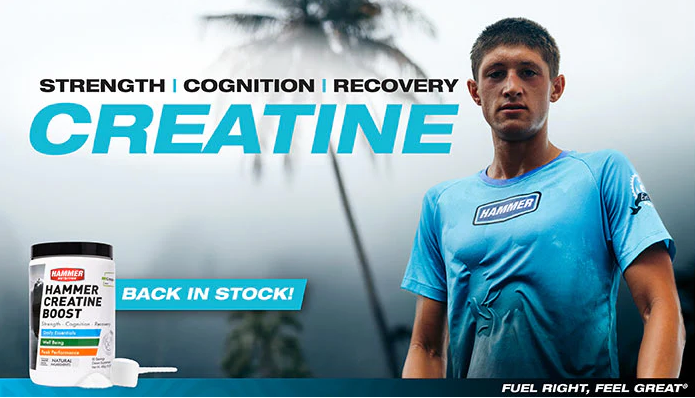
Creatine Boost – Huge Benefits for Endurance Athletes
BY STEVE BORN
There is no doubt that the hottest supplement on the market right now is creatine monohydrate (often simply called "creatine"). The reason? While creatine was once mainly used by athletes involved in strength and explosive sports—such as bodybuilders, weightlifters and sprinters—new research has shown that it offers significant benefits for all athletes. Even more importantly, it can provide valuable health benefits for the general population as well.
This new research is why, after more than 30 years, we have brought Creatine Boost back into our product range (yes, we had a creatine product many years ago!). With benefits that go far beyond simply building muscle size and strength, bringing it back was an easy decision. Another easy decision was choosing the highest-quality and most researched form of creatine available: Creapure® pure creatine monohydrate, produced by Alzchem Trostberg GmbH in Germany.
The Wide-Ranging Benefits of Creatine Boost
Helps Muscle Fibres Recover and Rebuild Stronger After Exercise
Exercise creates tiny tears in muscle fibres. During recovery, these micro-tears repair themselves and become stronger. Creatine, along with protein, supports this important process by helping activate satellite cells—specialised stem cells found within skeletal muscles—which assist in muscle repair and growth. [1]
Helps Reduce Exercise-Induced Muscle Soreness
In a study involving well-trained runners competing in a 30km race, researchers measured several markers linked to inflammation and muscle soreness, including creatine kinase, lactate dehydrogenase, prostaglandin E2 and tumour necrosis factor-alpha.
The runners who did not take creatine showed significant increases in all four markers after the race. In contrast, the runners who supplemented with creatine had much lower levels of these markers. The researchers concluded:
"These results indicate that creatine supplementation reduced cell damage and inflammation after an exhaustive, intense race." [2]
Hot Tip: Before an important race, try a 4-day loading phase with Race Day Boost. Adding 1 serving of Creatine Boost to one or two of the four daily loading doses during each of those four days may provide an excellent combination for both performance and recovery. Always test this strategy during training first.
Supports Faster Muscle Glycogen Recovery After Exercise
Researchers Bergström and Hultman explain:
"Muscle glycogen availability has long been cited as a principal determinant of endurance exercise performance, and its depletion corresponds with the development of muscle fatigue. Optimising liver and muscle glycogen storage is a goal of many athletes wishing to maximise performance."
Research has shown that creatine supplementation can increase the rate of glycogen replenishment and improve muscle glycogen storage following hard exercise. [3] This is a major benefit for endurance athletes.
Hot Tip: To maximise glycogen recovery and increase muscle glycogen storage, add 1 serving of Creatine Boost to Recoverite Taking 1 capsule each of Chromium GTF and Essential Mg may further enhance glycogen synthesis and storage. [4]
Provides Antioxidant Support
Research has shown that creatine can increase the activity of antioxidant enzymes and help neutralise harmful reactive oxygen species (ROS) and reactive nitrogen species (RNS).
Creatine also helps protect important cellular components, including mitochondrial DNA (mtDNA) and RNA, from oxidative damage. In addition, it supports other cellular processes that help cells survive and function effectively during periods of oxidative stress. [5]
Supports Brain Health
A review of numerous studies examining creatine's effects on brain health and function concluded:
"Creatine supplementation can increase brain creatine content, which over time may help explain some of the promising effects on measures of brain health and function."
Research has shown that creatine supplementation may:
- Improve cognitive function and memory, particularly in older adults.
- Help reduce the effects of sleep deprivation.
- Support recovery from traumatic brain injuries (TBI), including concussion.
- Improve some symptoms associated with muscular dystrophy.
- Show potential benefits for depression and anxiety, although more research is needed before firm conclusions can be drawn. [6]
Supports Cardiovascular Health
Research into creatine's effects on healthy human hearts is still ongoing. However, animal studies have shown that creatine supplementation can restore ATP levels during cardiac stress while reducing markers of heart muscle fatigue. Similar benefits have also been observed in healthy animals. [7,8]
Human studies involving individuals with chronic congestive heart failure have demonstrated that creatine supplementation increases creatine phosphate levels in muscle tissue, leading to improved performance in both strength and endurance tests compared to those who did not supplement with creatine. [9]
Helps Protect Against Age-Related Muscle and Bone Loss (Sarcopenia)
Sarcopenia refers to the gradual loss of muscle mass, strength and physical performance that occurs with ageing. It is often associated with reduced bone density and increased low-grade inflammation.
Research suggests that creatine supplementation may:
- Increase muscle mass in older adults.
- Improve muscle strength and physical performance.
- Reduce the risk of falls.
- Potentially help reduce inflammation.
- Support the maintenance of bone mineral density. [10]
These benefits make creatine an important consideration for healthy ageing.
First Time Ever: One Product, Three Categories
In Hammer Nutrition's 39-year history, no product—whether a supplement or fuel—has fitted perfectly into three separate categories. Creatine Boost does, and here's why:
Peak Performance
This is the most obvious category. Creatine has long been the supplement of choice for strength training, off-season conditioning and power-based sports. Its benefits for recovery further strengthen its place as a Peak Performance supplement.
Well Being
With its antioxidant properties, support for brain and heart health, and protection against age-related loss of muscle, strength and bone mass, Creatine Boost clearly belongs in the Well Being category.
Daily Essentials
Creatine does not work through receptor stimulation, and there are no known issues with tolerance or reduced effectiveness over time. Because its benefits build up gradually, Creatine Boost can be taken every day without interruption.
The benefits are cumulative, making daily use the best approach—for life.
Don't Wait! Get Your Supply of Creatine Boost Today
Three words we never like to say are: "supplies are limited."
At the moment, we have good stock levels of Creatine Boost and hope to keep it that way. However, creatine monohydrate is currently one of the most popular supplements available, and many companies are now using Alzchem Trostberg GmbH's Creapure® creatine monohydrate as their preferred ingredient.
As a result, global supplies of Creapure® have occasionally been inconsistent.
We are working hard to maintain a reliable supply of Creatine Boost. However, given the continued demand for Creapure® and the many benefits Creatine Boost provides, it would be wise to stock up now to avoid running out.
REFERENCES
[1] https://pmc.ncbi.nlm.nih.gov/articles/PMC1779717/
[2] Santos RV, Bassit RA, Caperuto EC, Costa Rosa LF. The effect of creatine supplementation upon inflammatory and muscle soreness markers after a 30km race. Life Sci. 2004 Sep 3;75(16):1917-24.
[3] https://pmc.ncbi.nlm.nih.gov/articles/PMC4974290/
[4] https://hammernutrition.com/blogs/endurance-news-weekly/a-powerful-pair-for-insulin-resistance
[5] https://pmc.ncbi.nlm.nih.gov/articles/PMC8000194/
[6] https://link.springer.com/article/10.1007/s40279-023-01870-9
[7] https://pubmed.ncbi.nlm.nih.gov/8719809/
[8] https://pubmed.ncbi.nlm.nih.gov/10069699/
[9] Gordon A, Hultman E, Kaijser L, et al. Creatine supplementation in chronic heart failure increases skeletal muscle creatine phosphate and muscle performance. Cardiovasc Res. 1995 Sep;30(3):413-8.