
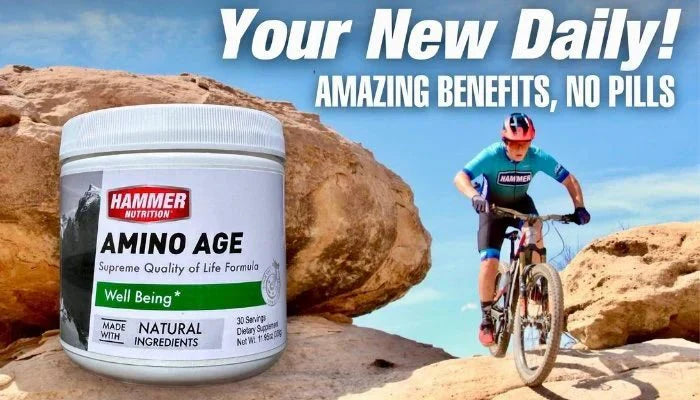
AMINO AGE (QUALITY OF LIFE)
BY STEVE BORN
Amino Age Key benefits
- Improved antioxidant function
- Supports healthy mitochondria and cell renewal
- Reduces aches and soreness, and helps protect against chronic inflammation
- Supports healthy insulin function and utilisation
As we get older, we all want to live as healthily as possible — to truly thrive. That is exactly why we created Amino Age. The four amino acids in this formula deliver powerful benefits, both because they affect so many areas of health and because of how strongly they support overall wellbeing.
Without trying to sound sensational, this is genuinely the most unique product Hammer Nutrition has ever made, and it offers a wide range of exceptional benefits for people of any age. Amino Age is a daily-use supplement, designed to work perfectly alongside all other Hammer Nutrition supplements. Its goal is to help you avoid many age-related issues so you can enjoy outstanding health. Start using Amino Age today and support strong, robust health every day.
The Amino Age formula
We spent a long time researching and reviewing amino acids for possible inclusion in Amino Age. We chose the four below because, more than any others, each provides multiple benefits — and those benefits are truly remarkable in how many areas of human health they support. Read on and you’ll see why.
Glycine (6,000 mg)
Glycine may be the simplest and smallest amino acid, but its benefits are anything but small. Here are some key examples:
Reduces aches and soreness and helps protect against chronic inflammation
Chronic inflammation is a persistent inflammatory state that can continue for a long time and may damage tissues and organs. Research shows glycine can work in two ways: it helps reduce pro-inflammatory cytokines such as TNF-α, IL-6, and IL-1β, while increasing the anti-inflammatory cytokine IL-10. [1]
A precursor to glutathione, one of the body’s most powerful antioxidants
Research states: “Hence, joint supplementation with NAC [N-acetyl cysteine, another component in Amino Age] and glycine could be expected to collaborate in stimulating glutathione production.” [2]
Helps improve gut health
Many research reports show that glycine deficiency is linked to oxidative damage and reduced intestinal barrier function, and that this can be improved with glycine supplementation. [3]
Supports the body’s production of collagen
Collagen is the most abundant protein in the body and is a key building block of skin, bones, muscles, ligaments, tendons, and other connective tissues. Because glycine is a major component of collagen, supplementing with glycine supports the body’s ability to produce collagen. [4]
May improve liver function
In male Wistar rat models of alcohol-induced liver damage, glycine supplementation reduced alcohol-related liver injury. Another study showed increased fatty acid oxidation and increased glutathione synthesis in the livers of mice with non-alcohol-induced liver injury. These findings suggest glycine supports the liver and helps protect it from long-term damage. [5]
Taurine (4,000 mg)
Let’s look at how researchers describe taurine — the most abundant amino acid in the human body — and it becomes obvious why it is a vital part of Amino Age:
“Considering its broad distribution, its many cytoprotective attributes, and its functional significance in cell development, nutrition, and survival, taurine is undoubtedly one of the most essential substances in the body.” [6]
Other researchers call taurine “a wonder molecule.” [7]
Older adults, on average, have 80% less taurine than young, healthy adults. One study even described taurine deficiency as a “driver of aging”. [8] For that reason, taurine supplementation is not just a good idea — it can be a necessity.
Powerful protection against type II diabetes
Animal studies suggest taurine supplementation can help reduce the onset of type II diabetes. [9,10] Studies in diabetic rats also show taurine supports heart function by helping protect against heart damage, partly by increasing glucose transport into heart muscle cells, which helps lower blood glucose. [11,12]
Excellent support for heart health
Taurine supplementation has been shown to help improve circulation, lower blood pressure, reduce arterial thickening, and enhance the beneficial effects of increased nitric oxide levels. [13,14,15]
Outstanding support for eye health
Taurine is found in very high concentrations in the retina, but levels decline significantly with age. Strong evidence indicates taurine is essential for maintaining optimal retinal function, so supplementing with taurine helps maintain that function. [16]
Highly beneficial for liver health
Alcoholic and non-alcoholic fatty liver disease can progress to cirrhosis and liver failure. Studies show taurine helps protect liver cells against free radicals and toxins, reducing the severity of oxidative stress-related liver injury. [17,18,19]
Interesting note
In one study, elderly mice given daily taurine increased life expectancy by up to 25% compared to placebo. [8] Similar results were found in rhesus monkeys supplemented with taurine. [20]
Special note
Because taurine offers many athletic performance benefits as well as overall health benefits, it is acceptable to use Amino Age alongside other taurine-containing products, Fully Charged and Cherry Bomb HEED.
N-Acetyl L-Cysteine (NAC) (600 mg)
N-Acetyl-L-Cysteine (NAC) is the bioactive form of the amino acid cysteine and is readily absorbed from the intestine. Key benefits include:
Boosts glutathione levels
NAC can increase glutathione on its own. [21] With glycine also included in Amino Age, glutathione production is supported even more. Since glutathione is one of the body’s most powerful antioxidants, maintaining strong glutathione levels is vital.
Strong support for the body’s detoxification processes
NAC may help reduce side effects linked to exposure to environmental toxins. One study states: “The use of NAC as a chelator of heavy metals appears to be a promising area of medical research and further clinical studies to verify these preliminary findings are warranted.” [22]
Exceptional liver protection
Alongside detoxification support, NAC’s liver-protective effects are significant. It is frequently used medically to treat liver toxicity linked to acetaminophen overdose. One reference states NAC “is the mainstay of therapy for acetaminophen toxicity… and is almost 100% effective if given within 8 hours post-ingestion.” [23]
Supports lung health and helps relieve respiratory symptoms
Excess mucus can build up in the airways, becoming sticky and difficult to clear, which makes breathing harder and worsens conditions such as bronchitis and asthma. NAC has been shown to reduce mucus thickness and mucus volume, helping clear airways and support easier breathing. [24,25,26]
Helps stabilise blood sugar
Animal studies suggest NAC may help stabilise blood sugar by reducing inflammation in fat cells and improving insulin resistance. [27]
Special note: Amino Age, with its glutathione-supporting components (glycine and NAC), is an ideal complement to LSA Caps.
L-Carnosine (500 mg)
L-Carnosine (often called carnosine) is a dipeptide made from beta-alanine and L-histidine. It is found in high concentrations in the brain, muscle, and gastrointestinal tissues in humans, and it is present in all vertebrates. [28] Its health benefits are wide-ranging — one paper even describes carnosine as “a molecule with multimodal mechanisms of action.” [29]
Powerful anti-glycating support
Carnosine’s most significant benefit is its anti-glycating effect. Glycation happens when sugar molecules bind to proteins, lipids, and nucleic acids, leading to advanced glycation end products (AGEs). Dr Laurie Barclay writes: “While glycation is a normal consequence of aging, it is far from desirable.” Dr Bayne French states that AGEs “are considered toxic; in fact, they’re also termed glycotoxins,” adding: “The more AGEs, the faster you age.”
In “Glycation Damage: A Possible Hub for Major Pathophysiological Disorders and Aging”, researchers link AGEs mainly with aging, neurodegenerative disorders, diabetes and its complications, atherosclerosis, renal failure, immunological changes, retinopathy, skin photoaging, osteoporosis, and progression of some tumours. That’s a long list of unwanted outcomes. Fortunately, research for over 20 years shows L-carnosine is a powerful anti-glycating nutrient. A 2005 paper states: “Carnosine has been shown to act as an anti-glycating agent, inhibiting the formation of advanced glycation end products (AGEs).” [30]
Special note: For more on AGEs, see Dr Bayne French’s article at
https://hammernutrition.com/blogs/endurance-news-weekly/advanced-glycation-endproducts-revisited
and Steve Born’s article at
https://hammernutrition.com/blogs/endurance-news-weekly/sugars-role-in-the-sinister-action-of-glycation-and-age-ing
Strong antioxidant properties
One paper states: “Carnosine has a number of beneficial antioxidant properties. For example, carnosine scavenges reactive oxygen species (ROS) as well as alpha-beta unsaturated aldehydes created by peroxidation of fatty acid cell membranes during oxidative stress.” [31]
Helps maintain telomere length
Telomeres are protective caps on the ends of chromosomes. In cultured cells, carnosine has been shown to reduce telomere shortening. Longer telomeres are associated with increased lifespan. [32]
Summary
We are extremely excited about Amino Age — it is a formula like no other. And we’re just as excited for you to add it to the top of your supplement “arsenal”, so you can start enjoying the many impressive benefits this one-of-a-kind product provides.
References
[1] https://pmc.ncbi.nlm.nih.gov/articles/PMC10379184/
[2] https://pmc.ncbi.nlm.nih.gov/articles/PMC5855430/
[3] https://www.sciencedirect.com/science/article/pii/S0022316622002656
[4] https://pmc.ncbi.nlm.nih.gov/articles/PMC6153947/
[5] https://www.metabolon.com/metabolites/glycine/
[6] Ripps H, Shen W. Review: Taurine: A “very essential” amino acid. Mol Vis. 2012;18:2673-86. Epub Nov 12, 2012.
[7] https://jbiomedsci.biomedcentral.com/articles/10.1186/1423-0127-17-S1-S6
[8] Singh P, Gollapalli K, Mangiola S, et al. Taurine deficiency as a driver of aging. Science. 2023 Jun 9;380(6649):eabn9257.
[9] Franconi F, Loizzo A, Ghirlanda G, Seghieri G. Taurine supplementation and diabetes mellitus. Curr Opin Clin Nutr Metab Care. 2006 Jan;9(1):32-6.
[10] Kim KS, Oh da H, Kim JY, et al. Taurine ameliorates hyperglycemia and dyslipidemia by reducing insulin resistance and leptin level in Otsuka Long-Evans Tokushima fatty (OLETF) rats with long-term diabetes. Exp Mol Med. 2012 Nov 30;44(11):665-73.
[11] Tappia PS, Thliveris J, Xu YJ, Aroutiounova N, Dhalla NS. Effects of amino acid supplementation on myocardial cell damage and cardiac function in diabetes. Exp Clin Cardiol. 2011 Fall;16(3):e17-22.
[12] Das J, Vasan V, Sil PC. Taurine exerts hypoglycemic effect in alloxan-induced diabetic rats, improves insulin-mediated glucose transport signaling pathway in heart and ameliorates cardiac oxidative stress and apoptosis. Toxicol Appl Pharmacol. 2012 Jan 15;258(2):296-308.
[13] Murakami S. Taurine and atherosclerosis. Amino Acids. 2012 Dec 8.
[14] Abebe W, Mozaffari MS. Role of taurine in the vasculature: an overview of experimental and human studies. Am J Cardiovasc Dis. 2011;1(3):293-311.
[15] Rahman MM, Park HM, Kim SJ, et al. Taurine prevents hypertension and increases exercise capacity in rats with fructose-induced hypertension. Am J Hypertens. 2011 May;24(5):574-81.
[16] Chesney RW. Taurine: its biological role and clinical implications. Adv Pediatr. 1985;32:1-42.
[17] Miyazaki T, Bouscarel B, Ikegami T, Honda A, Matsuzaki Y. The protective effect of taurine against hepatic damage in a model of liver disease and hepatic stellate cells. Adv Exp Med Biol. 2009;643:293-303.
[18] Gentile CL, Nivala AM, Gonzales JC, et al. Experimental evidence for therapeutic potential of taurine in the treatment of nonalcoholic fatty liver disease. Am J Physiol Regul Integr Comp Physiol. 2011 Dec;301(6):R1710-22.
[19] Chen X, Sebastian BM, Tang H, et al. Taurine supplementation prevents ethanol-induced decrease in serum adiponectin and reduces hepatic steatosis in rats. Hepatology. 2009 May;49(5):1554-62.
[20] McGaunn J, Baur JA. Taurine linked with healthy aging. Science. 2023 Jun 9;380(6649):1010-1.
[21] Salamon S, Kramar B, Marolt TP, et al. Medical and Dietary Uses of N-Acetylcysteine. Antioxidants (Basel). 2019 Apr 28;8(5).
[22] https://link.springer.com/chapter/10.1007/978-981-10-5311-5_10
[23] https://www.ncbi.nlm.nih.gov/books/NBK537183/
[24] Kalyuzhin OV. Effect of N-acetylcysteine on mucosal immunity of respiratory tract. Ter Arkh. 2018 Apr 19;90(3):89-95.
[25] Santus P, Corsico A, Solidoro P, et al. Oxidative stress and respiratory system: pharmacological and clinical reappraisal of N-acetylcysteine. COPD. 2014 Dec;11(6):705-17.
[26] Aldini G, Altomare A, Baron G, et al. N-Acetylcysteine as an antioxidant and disulphide breaking agent: the reasons why. Free Radic Res. 2018 Jul;52(7):751-62.
[27] https://pmc.ncbi.nlm.nih.gov/articles/PMC5124332/
[28] https://pubmed.ncbi.nlm.nih.gov/34203479/
[29] Caruso G. Unveiling the Hidden Therapeutic Potential of Carnosine, a Molecule with a Multimodal Mechanism of Action: A Position Paper. Molecules. 2022 May 20;27(10).
[30] https://pmc.ncbi.nlm.nih.gov/articles/PMC6147582/
[31] https://pubmed.ncbi.nlm.nih.gov/34203479/
[32] Shao L, Li QH, Tan Z. L-carnosine reduces telomere damage and shortening rate in cultured normal fibroblasts. Biochem Biophys Res Commun. 2004 Nov 12;324(2):931-6.