
THE SODIUM WAR IS OVER!
BY :BRIAN FRANK
There has been a debate in the sports nutrition industry for more than 25 years about sodium intake. The opposing positions are typically described as “high sodium” and “low sodium”. Until 1996, much of the published evidence cited by high sodium advocates consisted of sweat studies. In contrast, the low sodium position was supported largely by athlete reports and practical experience, with limited direct published data.
One claim associated with the low sodium position is that lowering dietary sodium intake can improve tolerance to heat stress. With the introduction of Hammer Nutrition’s Endurolytes® formula in 1997, described as a full-spectrum, all-chelated, proportionately balanced electrolyte replacement supplement, athletes were offered an alternative to high-dose sodium products commonly referred to as “salt pills”.
Hammer Nutrition has stated since the 1990s that a high-sodium diet and high sodium replacement during heat exposure may contribute to undesirable outcomes for some athletes. The company has also pointed to broader public health literature linking high sodium intake with higher blood pressure and increased risk of cardiovascular disease and other health conditions.
Some high sodium advocates argue that endurance athletes training or competing in hot conditions should consume sodium at higher levels, including during exercise, and that sodium losses during activity should be replaced aggressively. This position often references laboratory sweat studies measuring sweat rate and sodium concentration during tests in heat. A limitation raised by critics is that many such studies do not account for participants’ dietary sodium intake in the days or weeks prior to testing. Another concern is the assumption that sodium losses measured over a short test period will remain constant over multiple hours of competition, and that intake targets should match the measured loss.
The debate also raises additional questions, including whether some athletes are predisposed to higher sweat rates in heat, whether sodium concentration in sweat varies widely between individuals, and whether these variables can be modified through dietary intervention.
Conventional advice has often interpreted cramps or heat-related symptoms during hot events as evidence of inadequate fluid and sodium intake, with the recommendation to increase both in future events. It has been argued that this can contribute to further gastrointestinal distress and other complications in some athletes. Some practitioners and product manufacturers continue to recommend high sodium strategies.
Hammer Nutrition’s stated position is that sweat rate and sodium losses during exercise reflect recent dietary sodium intake habits: higher habitual sodium intake is associated with higher sweat sodium concentration and higher sodium losses, while lowering dietary sodium intake reduces both sweat rate and electrolyte loss during heat exposure. For many years, the company states, this position was supported mainly by athlete feedback rather than published experimental data designed specifically to test the hypothesis.
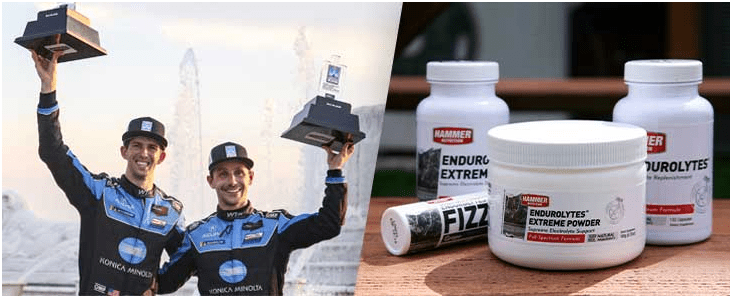
A source of empirical data cited in support of this position comes from work involving the Wayne Taylor Racing (WTR) IMSA endurance racing team in the United States, which operates a driver science programme established in 2016. Part of the programme used technology from a company called CoreSyte, described as producing real-time, non-invasive digital sweat patches that measure total fluid loss, sodium loss, and potassium loss.
Within this context, one driver, Ricky Taylor, reportedly experienced substantial fluid and electrolyte losses during endurance races in hot conditions prior to dietary changes. After discussions about diet, training, and hydration practices, he adopted a lower sodium and lower sugar dietary approach alongside the use of Hammer products. CoreSyte’s patch-based monitoring was used to track sweat sodium concentration, and pre- and post-stint body weight measurements (taken in underwear to reduce measurement interference from absorbed sweat in race gear) were used to estimate fluid loss. Because the team had collected measurements before the diet changes, baseline values were available for comparison.
Following an extended period of implementation, results reported after the 24 Hours of Daytona in January 2021 indicated reductions in both fluid loss and sweat sodium concentration. The reported changes were up to a 25% reduction in fluid loss and up to a 40% reduction in sodium losses. More specifically, the report describes a 20–25% reduction in fluid loss and a 33–40% reduction in sweat sodium concentration, with ranges attributed to continuous monitoring over multiple hours.
Conclusion
These observations are presented as support for the claim that reducing daily sodium intake can improve tolerance to heat and humidity during prolonged endurance activity. It is also noted that critics may argue that this is a single case context rather than a double-blind controlled trial, and therefore should not be treated as definitive on its own. However, it is described as consistent with Hammer Nutrition’s long-standing position and with broader research often cited regarding potential long-term health risks associated with high dietary sodium intake.